News & Events
Navarathri Pooja
The Indian festival of Navratri has been derived from two words—"Nav" + "Ratri", which means "nine nights" in English. This festival is prevalent throughout India, but it is more prominent in the state of Gujarat and Bengal. Hindus celebrate this festival to express their devotion to the goddess of power, Durga. The worship of the goddess Durga continues for nine days. Each day, a different form of the goddess is worshiped. Following the nine days of rituals and worship, the 10th day is celebrated as Dussehra, which is also known as Vijay- Dashmi. It is celebrated to mark the victory of mythical King Lord Rama over the King of Sri Lanka, Ravana.
What is the celebration of Navratri?
Navratri or the festival of nine nights is celebrated with full fervor and enthusiasm in the Indian subcontinent. The festival is celebrated with devotion for a period of 10 days in India. Though the festival is of nine nights the festivity gets stretched top the tenth day. It is on the tenth day on which the idol of Goddess Durga is immersed in the holy water after worshipping. Different forms of the goddess are worshipped for nine days to enhance the physical, spiritual and mental well-being. As per the Hindu calendar Navaratri occurs during the month of Ashvin in the early autumn.
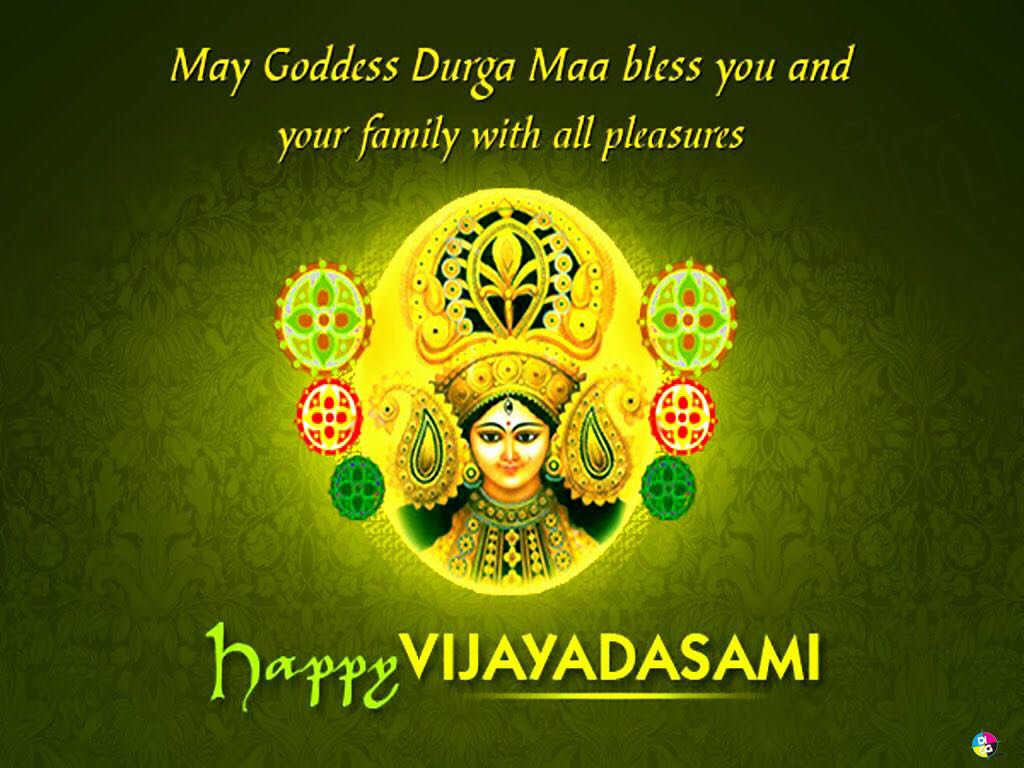
Navratri Card
What is the story of Navratri?
There are several stories related to Navratri but there are two stories which are the most prevalent ones. Mahishasura, a demon worshipped Lord Shiva with full devotion. The lord got so impressed by his great dedication that he gave him a boon to not get killed either by man or by God. After getting a boon of eternity Mahishasura became proud and arrogant. He unleashed a reign of terror everywhere and created problems for everybody. He didn't stop there and further initiated an attack on heaven which now scared the Gods too. Several Gods assembled and tried to fetch a remedy to get rid of nuisance of Mahishasura. Finally, a solution was obtained by creating a new Goddess by amalgamating the powers of all the male Gods. Mahishasura kept hiding and disguising himself for nearly 8 days but it was on 9th day that Maa Durga was able to find him and slew his head.
Maa Durga represented the good and Mahishasura represented the evil. So, the killing of the demon Mahishasura is celebrated as the victory of Good over evil.
The other story associated with the festival is of Lord Rama and Ravana. Lord Rama was a worshipper of Devi Bhagwati, the supreme power. He worshipped her for nine consecutive nights to emerge victorious over Ravana in the Dharm Yuddh. On the ninth day, Lord Rama proved his devotion to the devi and it was on the tenth day he emerged victorious after killing Dashanan (Ravana). Since then different incarnations of Devi Bhagwati are worshipped and it is on the tenth day Vijaya Dashmi is celebrated.
known as Vijay- Dashmi. It is celebrated to mark the victory of mythical King Lord Rama over the King of Sri Lanka, Ravana.
worshipped and it is on the tenth day Vijaya Dashmi is celebrated.